Why Can I Do Really Hard Things but Struggle With Easy Ones?
 Lindsey Peterson

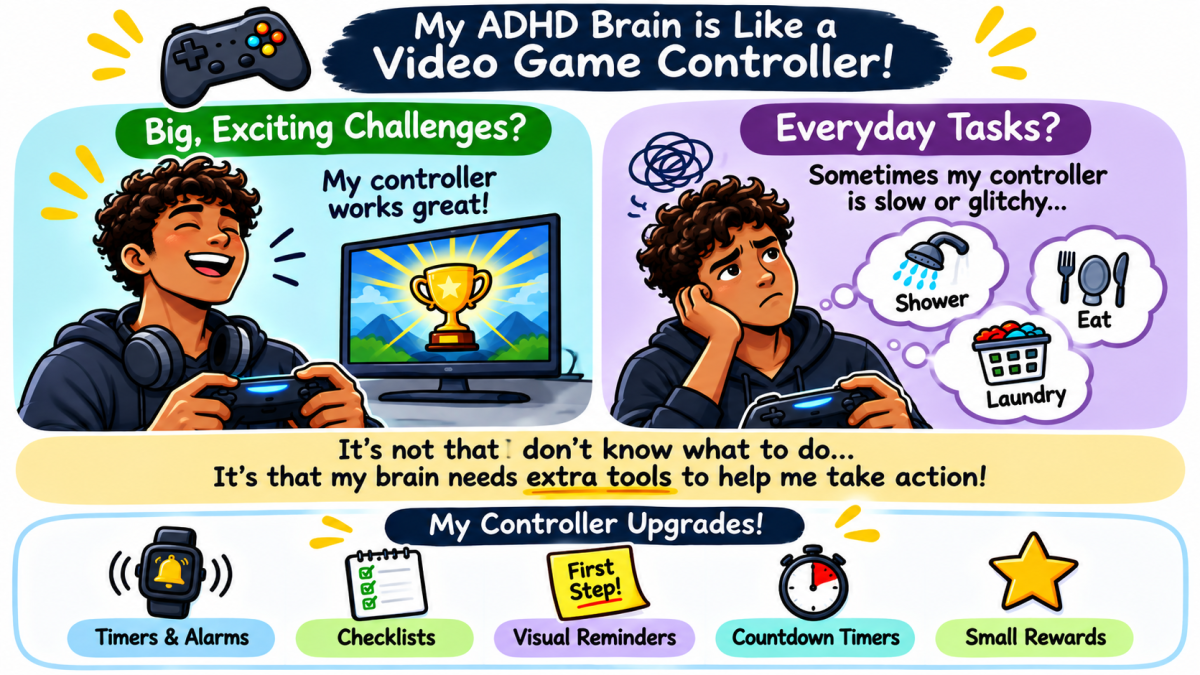
Why can those with ADHD excel at big challenges but struggle with simple tasks? Discover how the ADHD brain works and the tools that make everyday tasks easier.
Understanding ADHD Through a Video Game Controller
Have you ever been really good at something challenging, like winning a debate tournament, playing a sport, solving a complicated problem, or mastering a difficult video game level?
But then someone asks you to do something simple, like take a shower, put your clothes away, or remember to turn off the oven, and suddenly it's a struggle?
Maybe you get distracted. Maybe you forget. Maybe you know exactly what you need to do, but you just can't seem to get yourself moving.
And maybe you've heard someone say:
"If you can do something that hard, why can't you do something this simple?"
It's a fair question. And there's actually a pretty interesting explanation.
Your ADHD Brain Is Like a Video Game Controller
Imagine you're playing your favorite video game.
You're really good at it. You know the controls, you've mastered the strategies, and you can beat levels that other people find incredibly difficult.
When the game gets exciting, you're locked in. Your fingers move quickly, you make decisions, and everything seems to work.
But now imagine that sometimes your controller doesn't respond the way you expect.
You press the button to jump, but your character doesn't jump right away.
You try to switch directions, but your character keeps running the other way.
Or you get so focused on one part of the game that you forget about another mission you're supposed to complete.
That's a little like what happens with ADHD.
Your brain has the skills. You know what you're supposed to do. But the system that helps you start, stop, switch, remember, and finish tasks doesn't always respond consistently.
These skills are called executive functions.
Why Does My Controller Work Great Sometimes?
Here's where ADHD gets interesting.
Your brain's ability to focus and take action can change depending on what you're doing.
When something is exciting, challenging, interesting, or urgent, your brain often has an easier time getting engaged.
Think about a debate tournament.
You have:
- A clear goal: Win the debate.
- A challenge: Think quickly and respond to your opponent.
- Excitement: You're competing!
- Structure: Someone tells you when to start and stop.
- Immediate feedback: You can see how things are going.
It's like playing a video game where the mission is clear, the action is exciting, and you know exactly what you're working toward.
Your controller has lots of signals helping it respond.
Now think about taking a shower.
There's no competition. No exciting challenge. No immediate reward.
You have to stop whatever you're currently doing, remember what time it is, get your things together, and actually start.
Your brain has to create its own motivation, reminders, and structure.
And that's often much harder for someone with ADHD.
It's not because showering is harder than debating.
It's because the two activities require different kinds of brain skills.
Sometimes the Hardest Part Is Just Pressing Start
Imagine you're sitting on the couch and know you need to shower.
You think, "I'll go in a minute."
Then you remember something you wanted to look up.
While doing that, you notice something else.
Suddenly, 20 minutes have passed.
You didn't decide to ignore the shower. Your attention just kept getting pulled somewhere else.
Or maybe you don't get distracted at all.
Maybe you sit there thinking, "I need to shower. I need to shower. I need to shower."
But getting started feels weirdly difficult.
That's another way ADHD can show up.
Knowing what to do and getting your brain to take action are two different things.
It's like pressing the start button on your controller and having a delay before your character moves.
That delay can be frustrating, especially when the task seems easy.
So, How Do You Upgrade Your Controller?
Here's the good news.
You don't have to rely on your brain remembering everything or magically becoming better at boring tasks.
You can use tools that make it easier to take action.
Think of them like controller upgrades.
Upgrade #1: The Reminder Button
Use a vibrating watch alarm to remind yourself when it's time to do something.
Instead of hoping you'll remember to shower at 7:30, your watch gives you a signal.
You don't have to keep checking the clock. The reminder does that work for you.
Upgrade #2: The Mission Checklist
In video games, you often have a list of missions to complete.
You can create the same thing for everyday life.
Instead of thinking, "I have to get ready for bed," make a short checklist:
- Get pajamas.
- Take a shower.
- Brush teeth.
- Put dirty clothes away.
Now you don't have to hold every step in your head.
Upgrade #3: The Pause Button
Sometimes you're doing one thing when your brain suddenly wants to do something else.
Instead of immediately switching tasks, practice pausing and asking:
"What was my original mission?"
If the new idea isn't urgent, write it down and return to what you were doing.
Upgrade #4: The Countdown Timer
A timer can help you see how much time you actually have.
If you have 15 minutes to get ready, set a countdown.
This helps your brain recognize that time is passing, even when you're distracted.
Upgrade #5: The First Move
Sometimes the entire task feels overwhelming.
So don't focus on the whole mission.
Focus on the very first move.
Instead of "I need to take a shower," try:
"I'm just going to walk into the bathroom."
Once you've started moving, the next step may feel easier.
Upgrade #6: The Safety Backup
Some missions are too important to rely on memory alone.
For example, if you're cooking, use an oven timer and a reminder to check that the oven is off. Have an adult double-check until you've built a reliable safety routine.
Even skilled players need backup systems for important missions.
What About Parents?
Parents, here's something important to understand.
When your teenager can accomplish something incredibly impressive but struggles with everyday responsibilities, it's easy to assume they're just not trying.
But ADHD doesn't affect every task equally.
A teenager can be intelligent, responsible, motivated, and talented while still having genuine difficulties with remembering, starting, switching, or finishing everyday tasks.
That doesn't mean expectations should disappear.
It means we need to think differently about how to help them meet those expectations.
Instead of asking:
"Why can't you just remember?"
Try asking:
"What could we put in place so you don't have to rely on remembering?"
Instead of:
"You've been sitting there for 20 minutes. Just go shower!"
Try:
"What's making it hard to get started? Would a timer or a first-step reminder help?"
The goal isn't for parents to become their teenager's controller.
The goal is to help teenagers figure out which tools allow them to operate their own controller more independently.
A Challenge to Try Together
Pick one everyday task that keeps becoming a struggle.
Maybe it's showering on time, getting ready for school, remembering chores, or finishing the bedtime routine.
Then answer these three questions together:
- Where does the controller get stuck? Is it remembering, starting, switching tasks, keeping track of time, or finishing?
- What upgrade could help? A watch alarm, sticky note, checklist, timer, or something else?
- How will we know it's working? Try the tool for one week and see whether the task becomes easier.
If the first strategy doesn't work, that doesn't mean you've failed.
It means you need to try a different upgrade.
The Most Important Thing to Remember
Having ADHD doesn't mean you're not smart, capable, or responsible.
It means your brain sometimes needs different kinds of support to turn your abilities into actions.
And just because something looks easy from the outside doesn't mean it's easy for your brain to manage.
You don't need to become a better player. You need to learn how your controller works and which tools help you use it.
And parents, your job isn't to keep pressing the buttons for your teenager.
It's to help them discover the tools that allow them to take control themselves.
Because the goal isn't just to get through today's chores.
It's to build the skills and systems that help them navigate life independently, one mission at a time.
COULD ADHD BE PART OF THIS?
Have you ever wondered why you can accomplish incredibly challenging things but struggle with simple, everyday tasks? Maybe you lose track of time, get distracted easily, or have trouble getting started even when you know exactly what needs to be done. These experiences can happen for many reasons, but ADHD may be one piece worth exploring.
I created the free Could It Be ADHD? guide to help you understand how ADHD can show up in everyday life and recognize patterns that might leave you thinking, "Wait…that sounds like me."
Download the free Could It Be ADHD? guide →
Want more practical ADHD education like this?
Join my email list for practical ADHD education, resources, new articles, workshops, and tools to help you better understand ADHD—and learn to work with your brain, not against it.