When Estrogen Drops and ADHD Gets LOUD: A Guide for Women with ADHD and Their Partners
 Lindsey Peterson
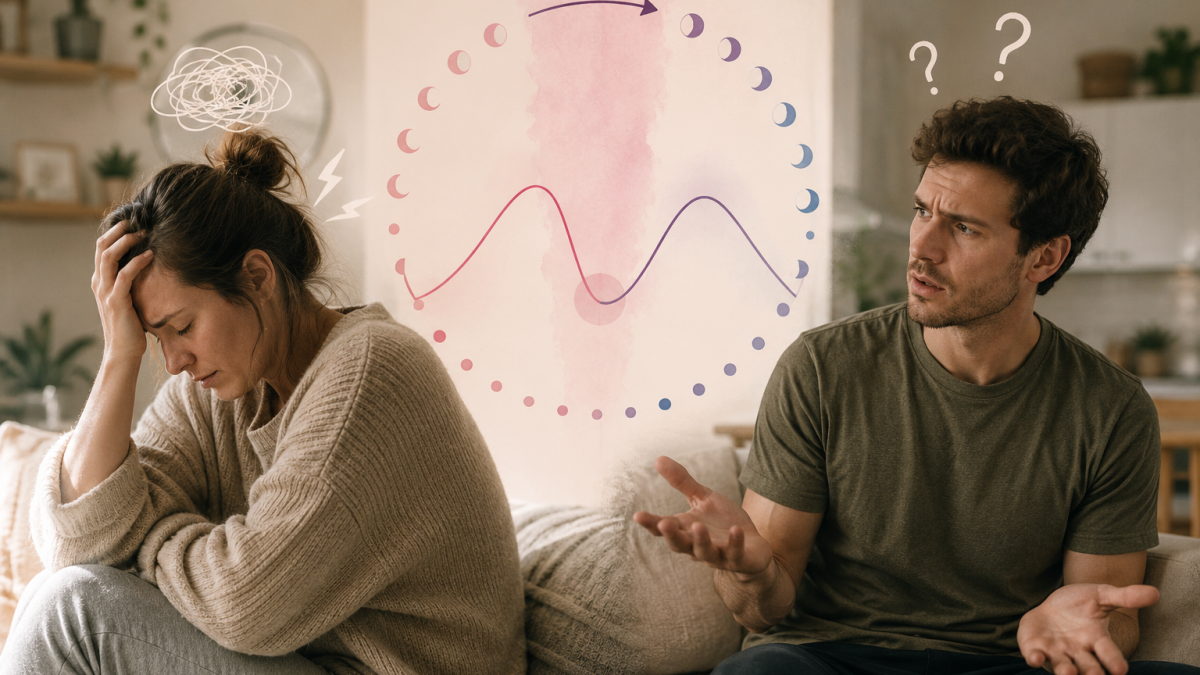
Learn how estrogen shifts can make ADHD feel louder—and how women and their partners can understand, prepare, and respond together.
Maybe you've had a day like this.
Everything is irritating you.
The kids are too loud. Your partner asks a completely normal question and somehow it feels like the most annoying question anyone has ever asked you.
You can feel yourself getting snappy.
You tell yourself:
Don't react.
Take a breath.
Walk away.
You know what to do.
And then—
BAM.
You snap anyway.
And afterward comes the shame.
Why was I such a bitch?
Why couldn't I control myself?
I know better.
Meanwhile, your partner may be standing there thinking:
What just happened?
And honestly?
You might both be wondering the exact same thing.
If you have ADHD, estrogen may be one piece of the puzzle.
Estrogen can affect how your ADHD feels
ADHD isn't only about attention.
It also affects things like emotional regulation, frustration tolerance, impulsivity, sensory overwhelm, motivation, and executive functioning.
Estrogen interacts with brain systems involved in many of these same areas.
So when estrogen fluctuates or drops, some women with ADHD notice that their symptoms get much LOUDER.
You might feel:
- more irritable
- more emotional
- more overstimulated
- less patient
- more rejection-sensitive
- foggier
- more impulsive
- less able to use your normal coping skills
And sometimes it feels completely confusing.
Why am I suddenly struggling so much today?
Look at what estrogen does throughout the cycle
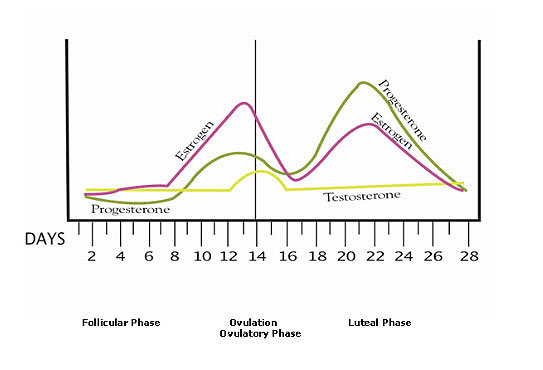
Estrogen isn't steady throughout the month.
It rises. It falls. It rises again. And it falls again.
There is often a noticeable decrease around ovulation and another decrease as you move toward your period. The exact timing and experience varies from person to person and even from cycle to cycle.
But this is why I don't want you only paying attention to:
When is my period coming?
Pay attention to the whole cycle.
Because sometimes that day when you suddenly think:
What the F is going on with me?!
may actually line up with a hormonal shift.
Seriously. Track it.
I do this myself.
Sometimes I'll genuinely be having one of those days where I cannot figure out what the F is going on with my brain.
I'm irritated.
My patience is gone.
Everything feels harder.
I'm more reactive.
Or maybe it's the next day and I'm thinking:
Wow. Why was I such a bitch yesterday?
And then I open my period tracker.
Ohhhhhhh.
Yep.
I'm right around the point in my cycle where estrogen decreases.
And suddenly I have context.
It doesn't erase what happened.
It doesn't mean I don't need to repair if I hurt someone.
But it changes the story from:
What is wrong with me?
to:
Okay. My capacity was really low. That makes sense. What do I need?
That clarity can be incredibly helpful.
You don't need a complicated tracking system
Use a period tracker.
Use your phone calendar.
Or literally make a note:
Day 14 — holy overstimulation.
Day 25 — irritable + brain fog.
Day 27 — NO patience.
Whatever works for your ADHD brain.
Pay attention to things like mood, irritability, sensory sensitivity, sleep, energy, focus, overwhelm, and emotional regulation.
You're not trying to blame every bad day on hormones.
You're looking for patterns.
Because if you start realizing:
Wait. This keeps happening around the same time...
That's useful information.
To the woman with ADHD: you may KNOW what to do and still struggle to do it
This is where so much shame comes in.
You know the coping skills.
You know you should pause.
Walk away.
Breathe.
Use your words.
Maybe you've literally been coaching yourself through it all day.
And yet sometimes it feels like the emotion hits before you can access any of it.
I know better. Why can't I DO better right now?
Your emotional buffer may simply be much smaller.
Something that normally annoys you at a 3/10 suddenly feels like a 9/10.
Noise.
Touch.
Clutter.
Interruptions.
Someone chewing.
Your partner asking another question.
Your kid saying:
Mom. Mom. Mom. Mom. MOM.
while you're trying to finish one freaking thought.
Everything feels like too much.
That doesn't mean you're powerless.
But the answer probably isn't simply:
TRY HARDER.
Sometimes the brain you're asking to use all those coping strategies has less capacity to access them.
To the partner: you may be getting the brunt of it
And that matters too.
You might be thinking:
Why is she so angry at me?
What did I even do?
Why am I walking on eggshells?
Why is everything I do wrong today?
Understanding what's happening hormonally doesn't mean you have to accept being treated badly.
But it may help to understand what's happening on the other side.
She may not be thinking:
I don't care how this affects you.
She may actually be thinking:
Why can't I get myself under control?
She may feel embarrassed.
Confused.
Overwhelmed.
Powerless.
And afterward, deeply ashamed.
Both experiences can be true:
She isn't doing it on purpose.
AND
It is still impacting you.
That's where the real work starts.
This is an explanation—not an excuse
This distinction matters.
"My hormones made me do it, so you have to deal with it."
No.
But neither is:
"Just control yourself."
Instead:
This isn't intentional AND it impacts the people around me.
We can understand what's happening while still taking responsibility for what happens.
Because understanding without accountability doesn't protect relationships.
But accountability without understanding can quickly turn into shame.
We need both.
Don't wait until the explosion to make a plan
Talk about this when everyone is calm.
Not while she's raging.
Not while you're defensive.
Not while the kids are screaming.
Maybe the conversation sounds like:
"I've noticed there are times when my capacity gets really low and I become much more reactive. I don't want us to keep being surprised by it. Can we figure out what helps when it happens?"
Now it isn't:
You vs. me.
It's:
Us vs. the pattern.
Create a low-capacity plan
What does your family do when you're running at 20%?
Maybe:
- expectations come down
- dinner gets simpler
- you get more quiet or alone time
- your partner takes something off your plate
- sensory input comes down
- unnecessary decisions can wait
- big relationship conversations get postponed
- you ask for help sooner
Not because anyone gets a free pass.
But because a brain at 20% capacity needs a different plan than a brain at 80%.
Say it before rage says it for you
Instead of waiting until:
EVERYONE LEAVE ME ALONE!
Try catching it earlier:
"I'm getting really overstimulated."
"I'm at about 20% today."
"I need some quiet."
"I don't think I can have this conversation well right now."
"I'm not mad at you. My brain just feels really loud."
You won't catch it every time.
The goal isn't perfection.
It's recognizing it earlier.
Partners: please don't weaponize the cycle
There's a HUGE difference between:
"You've mentioned this tends to be a harder time in your cycle. Do you think that might be happening today? What do you need?"
and:
"Are you on your period or something?"
One says:
I see you. I'm trying to understand. We're on the same team.
The other?
Probably isn't going to help.
And when you do snap? Repair.
You can say:
"I know I snapped at you. I was really overwhelmed, and you got the brunt of it. That wasn't fair to you. I'm sorry."
You don't need to turn that into:
"I'm horrible."
"I'm the worst mom."
"I'm such a bitch."
Shame doesn't repair relationships.
Accountability does.
What about perimenopause and menopause?
This conversation isn't only about menstrual cycles.
It can become especially important during perimenopause and menopause.
During perimenopause, hormones can become much more unpredictable.
You may notice:
- more brain fog
- worse sleep
- stronger emotions
- more irritability
- more overwhelm
- less frustration tolerance
- ADHD strategies not working the same
- symptoms appearing at unexpected times
And with menopause, estrogen levels remain lower overall than they were during the reproductive years.
For some women with ADHD, that can feel like:
Why is my brain suddenly so much harder to manage?
Or:
Why are the things that used to work for me not working anymore?
If you've spent years building systems that helped you function and suddenly those systems don't seem to hold you the same way, that can be incredibly confusing.
Tracking can still help.
During perimenopause, you might track your cycle along with your symptoms.
During menopause, when you're no longer tracking periods, you can still track things like sleep, mood, focus, irritability, overwhelm, sensory sensitivity, and overall ADHD functioning.
The goal isn't to perfectly predict your hormones.
It's to be able to say:
Here's what has changed. Here's what I'm noticing. Here's how it's affecting my life.
And if these changes are significant, new, or interfering with your daily life or relationships, bring that information to a healthcare provider.
The goal isn't to blame estrogen
It's to understand the pattern.
Looking at my period tracker and realizing:
Ohhhh. My estrogen dropped. That explains a whole lot about yesterday.
doesn't mean:
"Not my fault! Hormones!"
It means:
That makes sense.
My capacity was lower.
I need to repair what happened.
What do I need today?
And maybe next time I can recognize it sooner.
That's self-awareness.
And self-awareness gives us options.
Maybe the question isn't:
How do I force myself to act normal?
Maybe it's:
What does my brain need when my capacity changes?
And for the relationship:
How can we understand what's happening without either blaming her OR ignoring how it affects everyone else?
Understand the pattern.
Track it.
Talk about it.
Lower the demands when you can.
Communicate sooner.
Repair when you need to.
Get additional support when something feels significantly different.
And maybe eventually, instead of both of you standing there thinking:
What the hell is happening?!
you can recognize:
Oh. We're here again.
We know what this is.
We know what helps.
We're on the same team.
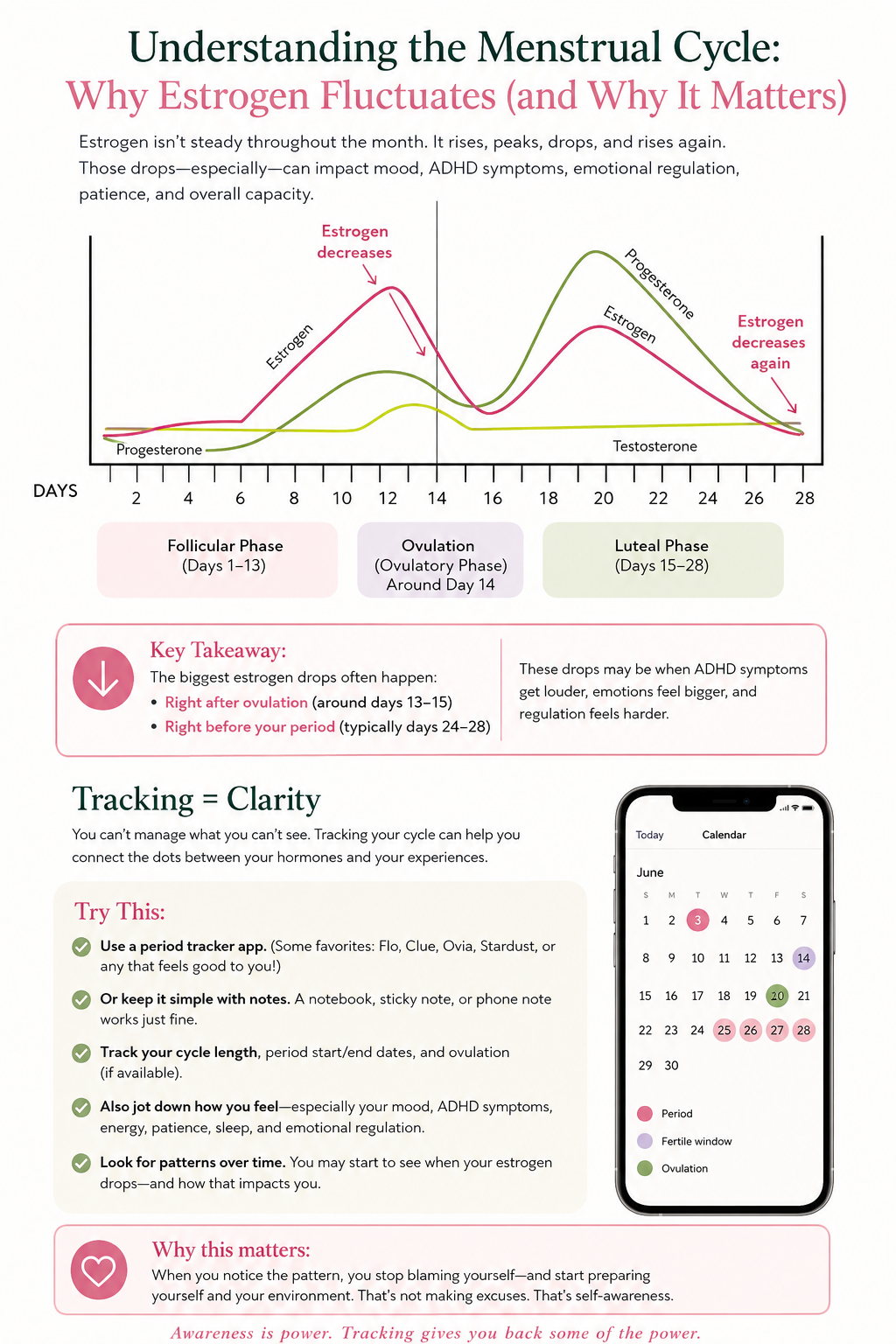
Want a visual that summarizes this?
Here is a helpful PDF that summarizes what this blog talks about and is helpful to have around for when estrogen drops and you are like WTF what just happened! Click here to download
Want more ADHD education like this?
Join my email list for practical ADHD resources, new blogs, and tools to help you better understand your brain.
[Click here to JOIN THE EMAIL LIST]