ADHD-Friendly Meal Planning: Stop Deciding What’s for Dinner Every Day
 Lindsey Peterson
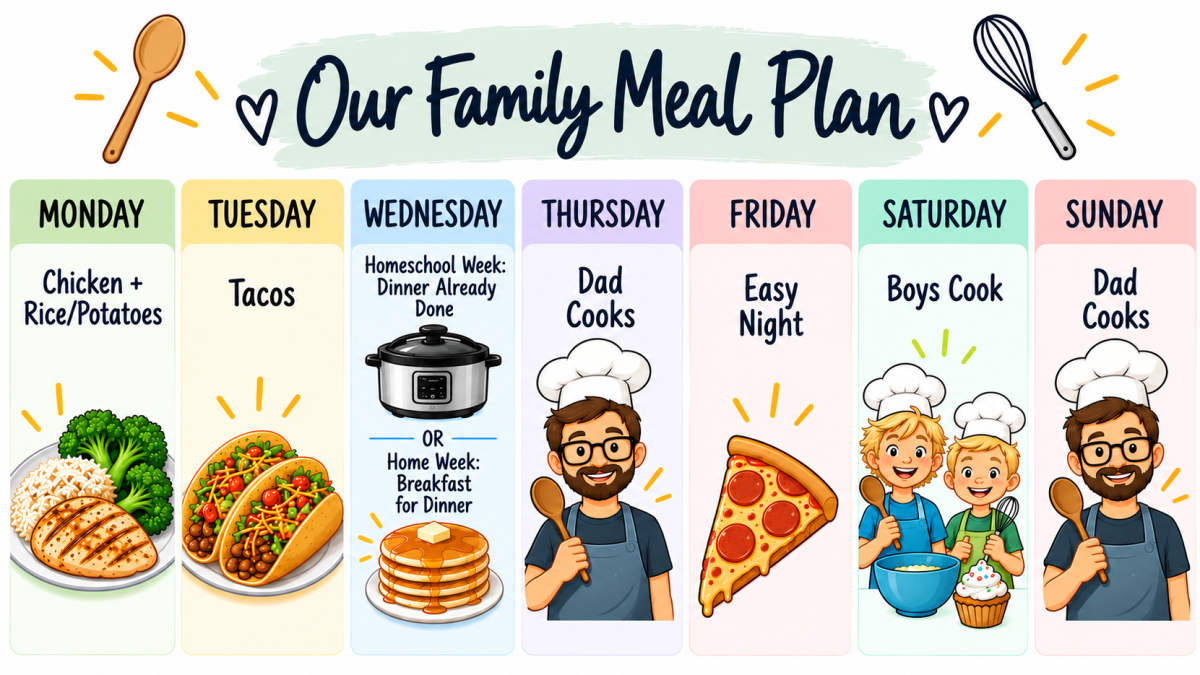
An ADHD-friendly approach to meal planning that reduces decisions, works with your family's real life, and makes dinner easier.
“What are we having for dinner?”
Uggggghhhhhhhhh.
Seriously.
Even typing that question, I can feel the absolute and total dread that comes with it.
Because when you have ADHD, “What's for dinner?” can feel like a ridiculously complicated question.
It's not actually one decision.
You have to think about what food you have, what everyone likes, what you can afford, how much time you have, how much energy you have, what needs to be used up, whether you need groceries, who is going to cook—and then actually initiate making the food at the right time.
And then tomorrow?
You have to decide again.
Uggggghhhhhhhhh. Again!!
And the next day.
And the next day.
No wonder this seemingly simple question can feel like such a freaking burden.
So this weekend, my family started talking about how we could make meal planning require less thinking.
Here's the idea
Instead of choosing seven completely different dinners every week, give each day an anchor based on your family's actual schedule, capacity, budget and needs.
Then when it's time to meal plan, you aren't starting with:
“What in the entire universe could we possibly eat this week?”
Part of the decision has already been made.
You're making a smaller decision inside a category.
That's what we decided to experiment with in our house.
Our current meal rhythm:
Monday: Chicken + rice/potatoes
Tuesday: Tacos
Wednesday: Dinner already made on homeschool weeks / breakfast for dinner on home weeks
Thursday: Dad cooks
Friday: Easy night
Saturday: Boys cook/bake with parent support
Sunday: Dad cooks
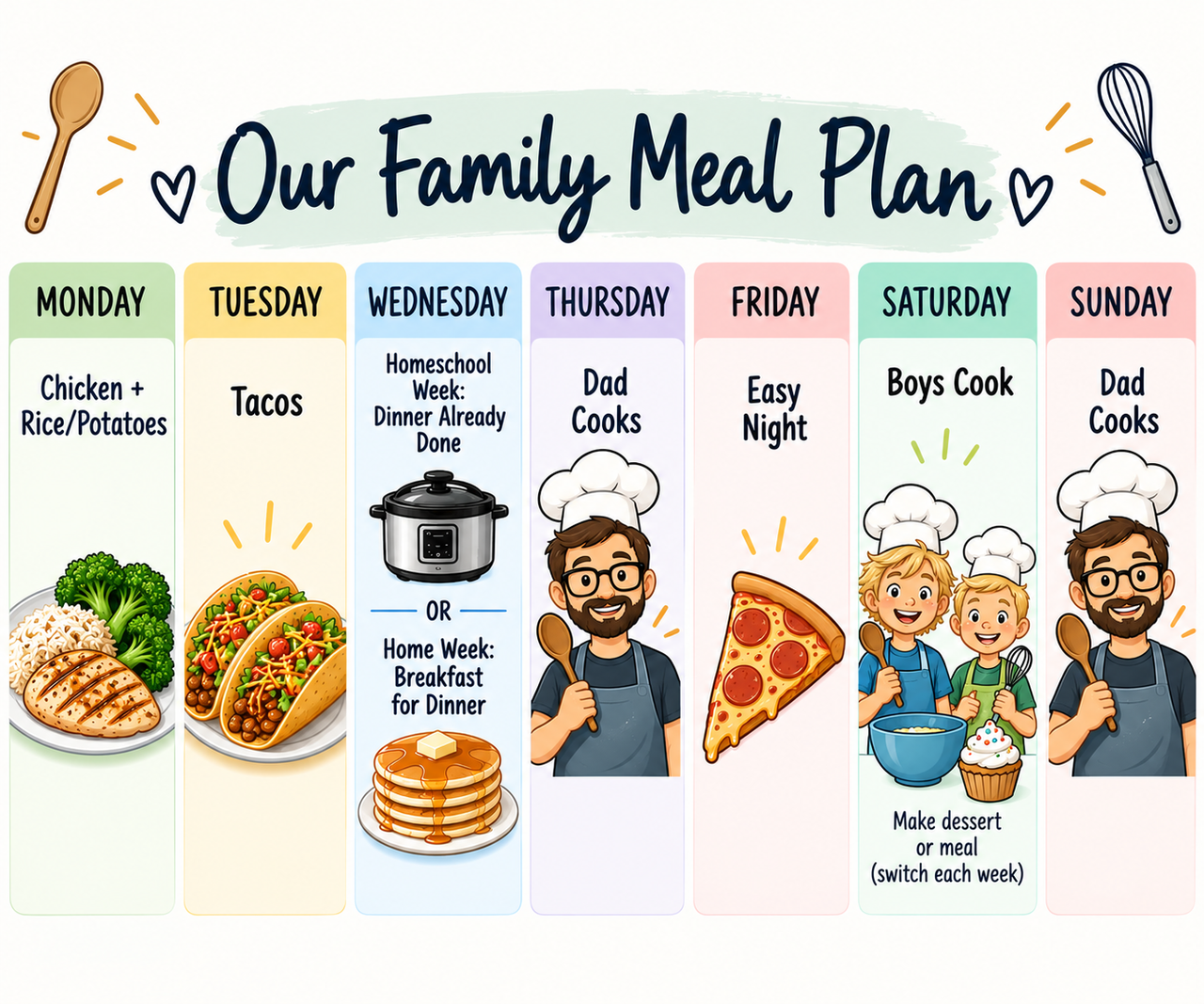
This is what works for our family.
Keep reading and I'll walk you through why we chose each day—because that's the part that can help you create something that actually fits yours.
Start with your actual week—not an ideal one
I didn't want another beautiful meal-planning system that we'd use for two weeks and abandon.
I wanted fewer decisions.
So instead of starting with:
“What seven meals should we make this week?”
We started with:
“What does our family actually need on each day of the week?”
I only see clients Monday through Wednesday.
That isn't going to match most families' schedules—and that's exactly the point.
Maybe you work Monday through Friday.
Maybe someone works weekends.
Maybe Tuesday is soccer.
Maybe Wednesday is church.
Maybe Thursday is the night everyone gets home late.
Your meal plan shouldn't look like mine.
It should reflect your family's actual life.
Plan meals around your family's capacity
One thing we've learned in our house is that my husband loves cooking.
He genuinely enjoys making more involved meals. It's an opportunity for him to be creative.
But trying to do that on a night that I've worked?
It absolutely blows up.
We're hungry. The kids are getting feisty. I'm depleted. He's trying to make something that requires time and concentration.
Suddenly something he normally enjoys becomes stressful, and we're all irritated with each other.
The problem isn't cooking. The timing doesn't match the capacity of our household.
So instead of thinking:
Dad loves cooking, so Dad should cook.
We asked:
When does our household actually have the capacity for Dad to ENJOY cooking?
For us, that's Thursday and Sunday.
Those became Dad's cooking nights.
This is one of the biggest things I want you to consider when creating your own routine:
Don't just ask what needs to happen.
Ask when your household can actually support it happening.
Start with food your family will actually eat
Before searching Pinterest for a bunch of new recipes, start with something much simpler:
What meals does your family already like?
Not the meals you wish everyone liked.
Not the recipe you saved six months ago because it looked healthy.
The meals you know people will actually eat.
Then ask:
Which of those meals are actually easy to make?
Those meals are GOLD.
Write them down.
You don't need 50 recipes to create a meal system.
You need enough reliable meals that you aren't starting from a blank page every week.
Give each day an anchor
We looked at our workweek first.
Monday is a workday, so we decided:
Monday = chicken + rice or potatoes
That doesn't mean we're eating the exact same meal every Monday.
It could be stir-fry one week.
Roasted chicken and potatoes another week.
Teriyaki chicken bowls.
Sheet-pan chicken and vegetables.
Something completely different.
We still get variety.
But when we're planning the week, we aren't searching the entire universe of dinner possibilities.
We're asking:
“What chicken meal sounds good this Monday?”
That's a much smaller question.
Cost also came into this decision.
Meat has gotten expensive, and chicken is one of the more affordable options available to us right now.
Instead of ignoring that reality, we built it into our routine.
Tuesday = tacos
Again, there's plenty of flexibility.
Traditional tacos.
Taco bowls.
Chicken tacos.
Quesadillas.
Nachos.
And here's another discovery we've made because of grocery prices:
Ground beef has gotten expensive.
We decided to try ground pork in our tacos instead—and discovered we actually like pork tacos more than ground beef tacos.
So if you've never tried ground pork for tacos and think your family might like it, I'd encourage you to give it a try!
Sometimes a constraint doesn't make a system worse.
Sometimes trying to solve one problem—like lowering the grocery bill—helps you discover something your family likes even better.
Design around the nights that usually fall apart
Wednesday was particularly important.
Every other Wednesday, we have a homeschool group after I'm done working.
We know ourselves.
If we leave that group, drive home hungry, and there isn't food waiting for us, there is a VERY good chance we're going to say:
“Let's just go out to eat.”
We could keep doing that and then wonder why we're spending so much money eating out.
Or we can acknowledge:
This is a predictable trouble spot.
So we designed around it.
Homeschool Group Wednesday = dinner is already done
Crock-Pot.
Instant Pot.
Casserole.
Something made ahead.
I don't care what it is.
I just don't want to have to cook it when we get home.
And on the Wednesdays we don't have homeschool group?
Breakfast for dinner
Easy.
Predictable.
Everyone likes it.
Done.
Instead of relying on ourselves to magically have more energy on a night we already know is difficult, we changed the expectation.
Make room for things your family actually values
Our boys have been asking to be more involved with cooking and baking.
It's one of those things that's really easy to say:
“We should do that more!”
And then six months later realize you still haven't done it.
Because teaching kids to cook takes more time than cooking yourself.
So once again, we asked:
Where can our household actually support this?
For us, that's Saturday.
One boy will make the meal and the other will make dessert.
The next week, they'll switch.
My husband and I will also switch off which kid we're supporting—and I'm intentionally not making a rule about who helps whom.
Because let's be real.
Some weeks my patience has been particularly tested with one of my kids and I might think:
You know what? Dad can help you cook this week. 😂
And that's okay.
Or maybe that kid and I have been having a harder week and cooking together could actually give us some of the bonding time we need.
Then I'm going to think about the recipe too.
If there's already more tension between us than usual, that is probably NOT the week for us to attempt an elaborate new recipe together.
We're choosing something EASY.
Sometimes supporting the relationship means reducing the demands around it.
And sometimes one of the boys might choose a recipe that I have absolutely no interest in making—or something that seems way too complicated to me but sounds fun to my husband.
Guess who's helping with that one? 😂
Interest matters too.
With ADHD, having absolutely no interest in a task can make something that seems relatively simple feel unbearably difficult.
If another person in the household is better suited for that particular job, we're allowed to account for that.
The structure is simply:
Saturday = the boys help cook and bake
Everything underneath that can flex.
Who makes the meal?
Who makes dessert?
Which parent helps which kid?
What recipe are we making?
How complicated is it?
All of that can change depending on what's happening in our family that week.
Enough predictability to reduce decisions, with enough flexibility to account for the actual humans living in our house.
That's what I want from a routine.
Some nights should intentionally be easy
And then there's Friday.
Friday = EASY
Pizza.
Leftovers.
Sandwiches.
Frozen food.
Whatever.
One thing I think we sometimes miss when creating routines is that not every available space needs to become productive.
You don't need seven beautifully planned dinners.
Sometimes the most supportive thing you can intentionally put into a routine is:
Nothing difficult happens here.
Before you create your meal rhythm, ask yourself:
You don't need to answer 25 questions or create some elaborate spreadsheet.
Start here.
YOUR SCHEDULE
What is actually happening each day?
Which nights are busiest?
Which nights are you getting home late?
Which days are relatively open?
YOUR CAPACITY
When does your household usually have the least energy?
Which nights tend to become stressful around dinner?
When does cooking feel manageable?
When does it feel like WAY too much?
YOUR FOOD
What meals does your family actually like and eat?
Which of those meals are easy to make?
What meals can you reliably make even when you're tired?
YOUR TROUBLE SPOTS
When are you most likely to say:
“Screw it. Let's order something.”
Is there a predictable reason?
What would need to be different on that day to make dinner easier?
YOUR PEOPLE
Who actually enjoys cooking?
When do they have the capacity to enjoy it?
Do your kids want to participate?
Is there something you'd like your kids to learn?
Where could that realistically fit?
YOUR BUDGET
What foods fit your grocery budget right now?
Are there expensive ingredients you could use less frequently?
Are there cheaper substitutions your family might actually enjoy?
Then look at the whole picture.
Your meal rhythm should come from these answers—not from what somebody else's meal plan says your family should be doing.
Build for the 80%—adjust for the other 20%
Will we follow our meal plan perfectly every week?
Absolutely not.
I'd guess our normal weekly rhythm happens about 80% of the time.
The other 20%?
Someone has an appointment.
We're going somewhere.
There's an event.
We're tired.
Plans change.
So we change the meal plan.
The routine isn't ruined because we adjusted it.
A routine doesn't have to accommodate every possible circumstance.
It needs to make your normal life easier.
Build something that works for the 80%.
Adjust it for the other 20%.
Then come back to your default.
Treat your new routine like an experiment
Is this our forever meal routine?
Who knows!
And that's not the goal.
Right now, our goal is to try it for at least three weeks.
In my work with clients, I often encourage people to give a new routine about three weeks before deciding whether it works for them.
Because the first week can actually feel harder.
You're remembering something new.
You're figuring out how it works.
You're adjusting.
So I wouldn't necessarily interpret:
“This feels harder right now.”
as:
“This routine doesn't work.”
Give yourself some time to learn it.
But there's another word I use with clients ALL THE TIME:
Experiment.
Let this be an experiment.
Try the routine and notice:
What's working?
What's making life easier?
Where are we still getting stuck?
What do we dread?
What are we actually following?
What keeps getting skipped?
What needs to change?
The first week or so may take some adjustment.
But over time, the system should start taking burdens away.
If it doesn't?
Adjust it.
Move the cooking night.
Change the meal category.
Make something easier.
Throw out an idea completely.
There is no prize for following a routine that makes your household miserable.
The routine is supposed to serve your family—not the other way around.
Always do what works for you and your family.
The goal: make the next decision smaller
This is ultimately what I love about this meal plan.
It isn't really about chicken on Monday or tacos on Tuesday.
It's about reducing the number of decisions our brains have to make over and over and over again.
We still have flexibility.
We still get novelty.
We still change recipes.
But we're not beginning with a completely blank page every afternoon wondering:
“Uggggghhhhh...what are we going to eat?”
We've already made part of the decision.
Monday?
Chicken.
Okay. What chicken meal?
Tuesday?
Tacos.
Okay. What kind?
Wednesday homeschool week?
Something needs to be waiting for us.
Okay. What can we make ahead?
The first decision has already been made.
And sometimes that's exactly what an ADHD-friendly system needs to do.
Not eliminate every decision.
Just make the next decision smaller.
Want to create your own?
If you're looking at our visual meal schedule thinking:
“Okay...but how do I actually create something like this for MY family?”
I created The ADHD-Friendly Family Meal Rhythm Builder to help you do exactly that.
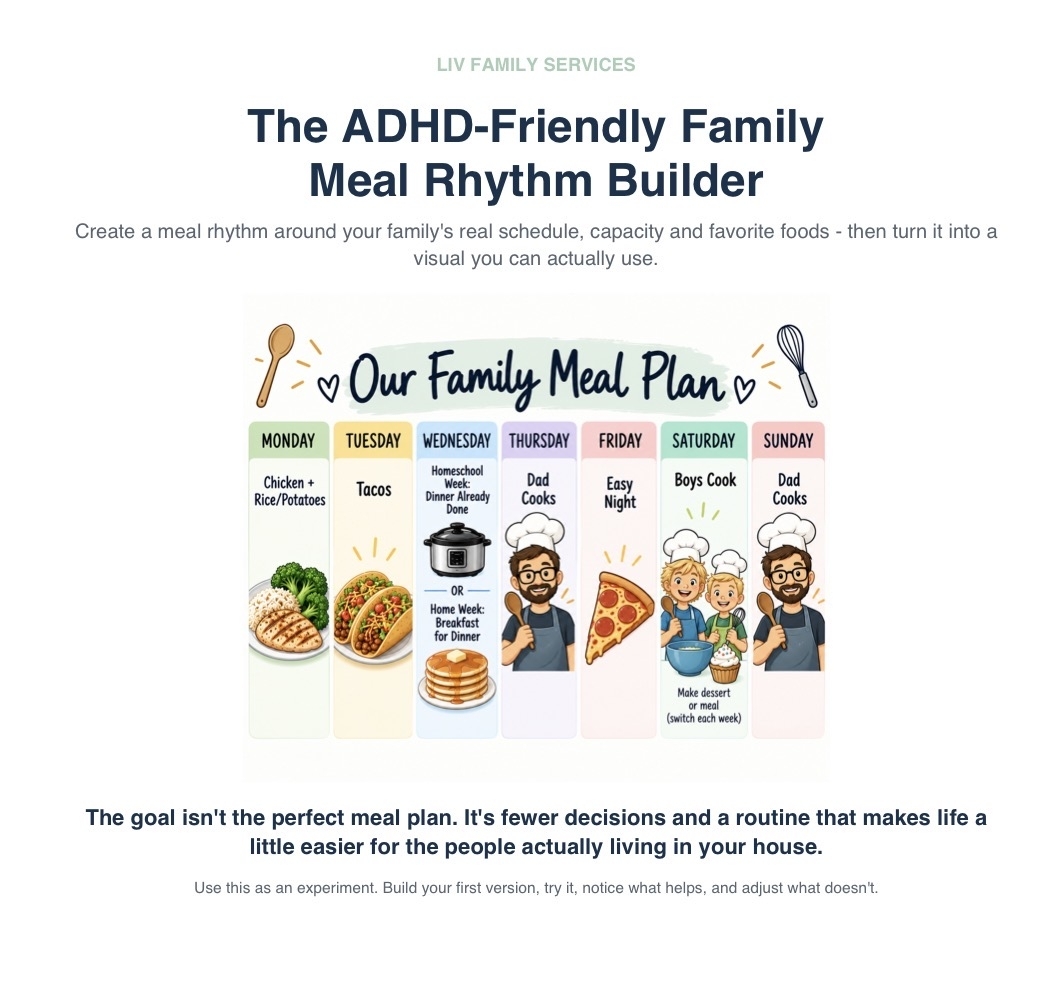
It walks you through your family's:
Schedule → Capacity → Favorite meals → Easy meals → Trouble spots → Budget → Weekly anchors
Then you'll use those answers to create your own weekly meal rhythm and visual schedule.
Not ours.
Yours.
Because the goal isn't to create the perfect meal plan.
It's to create one that makes life a little easier for the people actually living in your house.
[Click here to get The ADHD-Friendly Family Meal Rhythm Builder.]
Want more practical ADHD support?
I share new blogs, practical tools, visuals, and real-life ADHD strategies designed to make everyday life a little easier.