We All Have a Role to Play (Even When It Doesn’t Look Like What We Expected)
 Lindsey Peterson
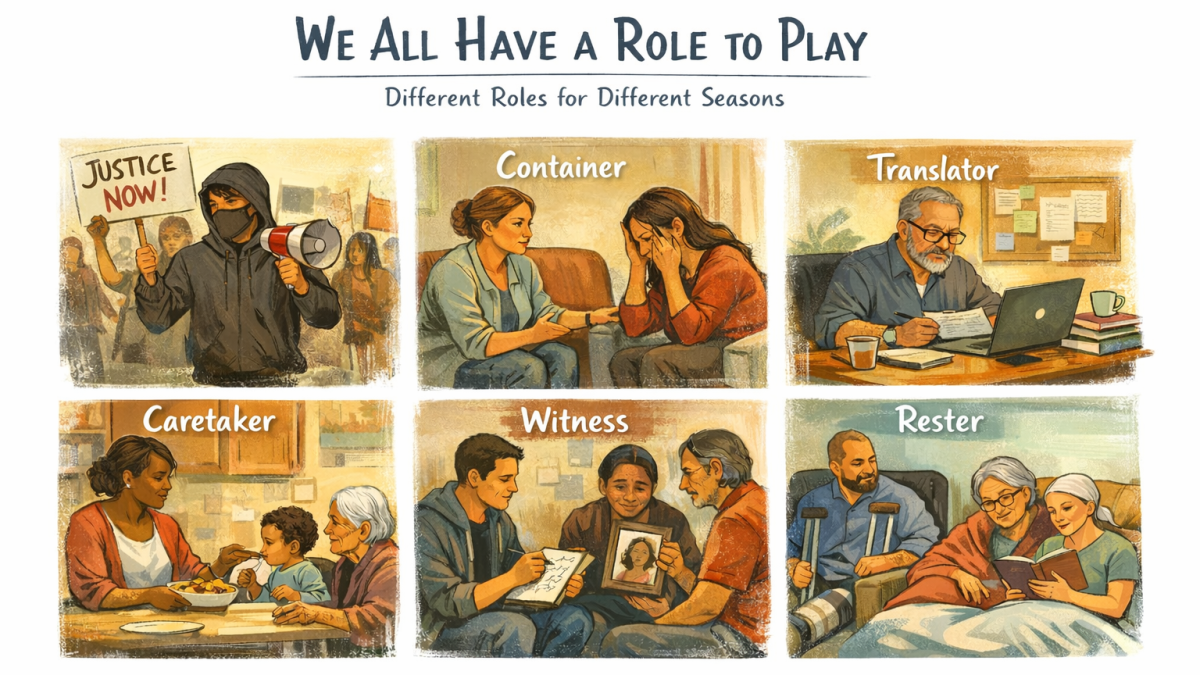
In times of crisis, we all play different roles. Learn how seasons, capacity, and regulation shape meaningful contribution.
In times of collective stress, injustice, or crisis, a familiar question emerges:
“Am I doing enough?”
It’s a question rooted in care—but it often becomes a source of guilt, comparison, and nervous-system overload. Especially when we see others mobilizing, protesting, organizing, or living in very real survival states, it can feel wrong—or even immoral—to remain steady, quiet, or focused on daily responsibilities.
But trauma science, community health, and lived experience all point to the same truth:
Healthy systems don’t require everyone to play the same role at the same time.
We all have a role to play.
And those roles look different from person to person, and change across seasons of life.
Roles Are Functions, Not Measures of Care
When stress levels rise, nervous systems organize themselves into different functions. These aren’t personality traits or moral identities. They’re adaptive roles that help the whole system survive and eventually recover.
You may recognize yourself in one (or more) of these roles right now.
1. The Mobilizers (Action & Frontline Roles)
Purpose: Interrupt harm, create visibility, respond to immediate threat
Examples: Protesters, organizers, rapid responders, community defenders
Duties of this role:
-
Act when waiting is unsafe
-
Bring attention to urgent injustice
-
Create movement and pressure for change
Tips to do this role well:
-
Pace yourself—burnout helps no one
-
Stay connected to regulated people
-
Build in recovery time, even if brief
-
Know when to hand off and step back
2. The Containers (Regulated Anchors)
Purpose: Hold steadiness so others don’t collapse
Examples: Therapists, parents maintaining routines, teachers, healthcare workers, elders
Duties of this role:
-
Offer emotional and nervous-system containment
-
Reduce the spread of panic and secondary trauma
-
Keep relationships, families, and care systems functioning
Tips to do this role well:
-
Protect your regulation fiercely
-
Limit overexposure to activating content
-
Remember that “quiet” does not mean “inactive”
-
Name your role to yourself so guilt doesn’t erase its value
3. The Translators (Sense-Makers)
Purpose: Create meaning, language, and context
Examples: Writers, educators, therapists, leaders who explain what’s happening
Duties of this role:
-
Help people understand their reactions
-
Reduce fear by increasing clarity
-
Translate chaos into something digestible
Tips to do this role well:
-
Speak with nuance, not urgency
-
Avoid oversimplification
-
Take breaks from consuming information so you can interpret it cleanly
4. The Caretakers (Sustainers & Repairers)
Purpose: Keep bodies, homes, and systems running
Examples: Parents, mutual aid coordinators, logistics helpers, caregivers
Duties of this role:
-
Feed, transport, organize, tend
-
Maintain routines that create safety
-
Repair what gets worn down
Tips to do this role well:
-
Ask for help when possible
-
Resist the belief that caretaking is “less than”
-
Acknowledge fatigue before resentment builds
5. The Witnesses (Memory Holders)
Purpose: Ensure experiences are seen, honored, and remembered
Examples: Therapists, artists, historians, community listeners
Duties of this role:
-
Bear stories others cannot yet hold
-
Validate pain without rushing to fix
-
Preserve truth so it isn’t erased
Tips to do this role well:
-
Ground after heavy witnessing
-
Stay connected to your body
-
Remember that witnessing is a form of justice
6. The Resters (Capacity Rebuilders)
Purpose: Restore energy for the future
Examples: People intentionally stepping back to heal, parents choosing rest over engagement
Duties of this role:
-
Downshift the nervous system
-
Rebuild capacity
-
Protect long-term sustainability
Tips to do this role well:
-
Release shame about rest
-
Trust that rest is preparation, not avoidance
-
Stay lightly oriented to the world without flooding yourself
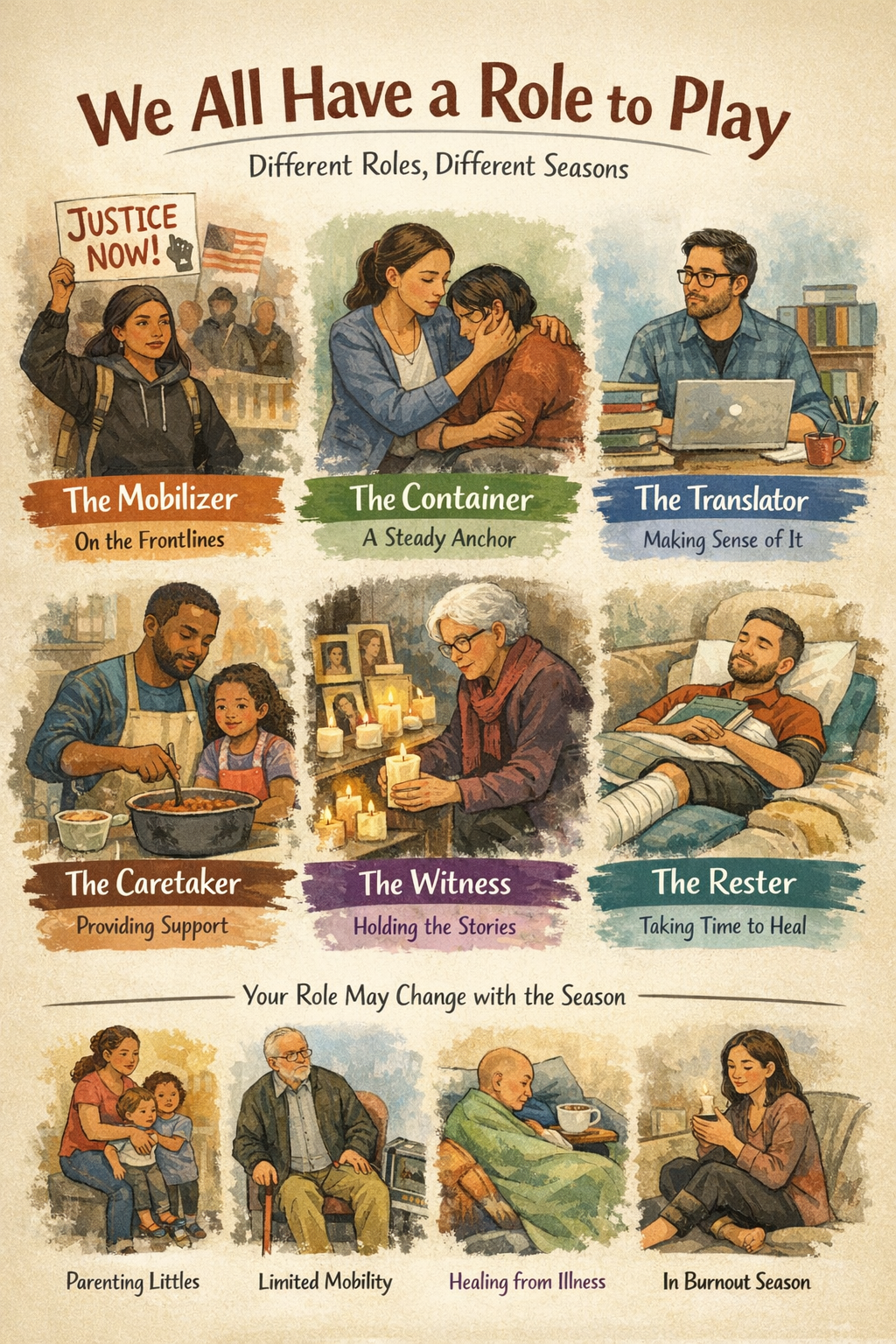
Seasons Matter
You may be in a season where:
-
You have young children
-
You’re the main breadwinner
-
Your nervous system cannot afford collapse
-
Your role looks quieter than it once did
That does not mean you care less.
It means your contribution is shaped by reality.
There may have been—or may be again—a season where you’re more visible, more active, more outwardly engaged. But this season asks something different.
It’s Wise to Know Your Role Today
The most trauma-informed question isn’t:
“What should I be doing?”
It’s:
“What role am I resourced to do well today?”
And here’s the key:
Your role can change tomorrow.
Your body knows.
There may come a moment when your system says:
-
“This requires more action from me now.”
-
“I can step forward without losing myself.”
Trust that signal.
Until then, maintaining your current role—especially if it’s one of regulation, care, or containment—is not failure. It’s wisdom.
A Final Reframe
If you’re feeling guilt because you’re not in survival mode while others are, remember this:
Not everyone is meant to be hypervigilant at the same time.
Some people are surviving the night.
Others are holding the ground so morning can come.
Both matter.
Both are necessary.
And neither negates the other.
Wherever you are today—let that be enough.
If this resonates, you’re invited to share it.
Share it with someone you’ve been talking this through with. Discuss it in your home, your workplace, or your community. Reflect on which role you’re in right now—and how that might shift with time.
You’re also welcome to share the visuals that go with this piece. Sometimes an image helps people name what words alone can’t.
Most importantly, let this be a starting point—not a conclusion.
A way to deepen understanding, reduce guilt, and honor the many ways people show up in hard times.
There is room for many roles.
And your role—right now—matters.
Download pdf of photos by clicking below