When It All Feels Like It’s Riding on You: ADHD, Urgency & The Spiral
 Lindsey Peterson
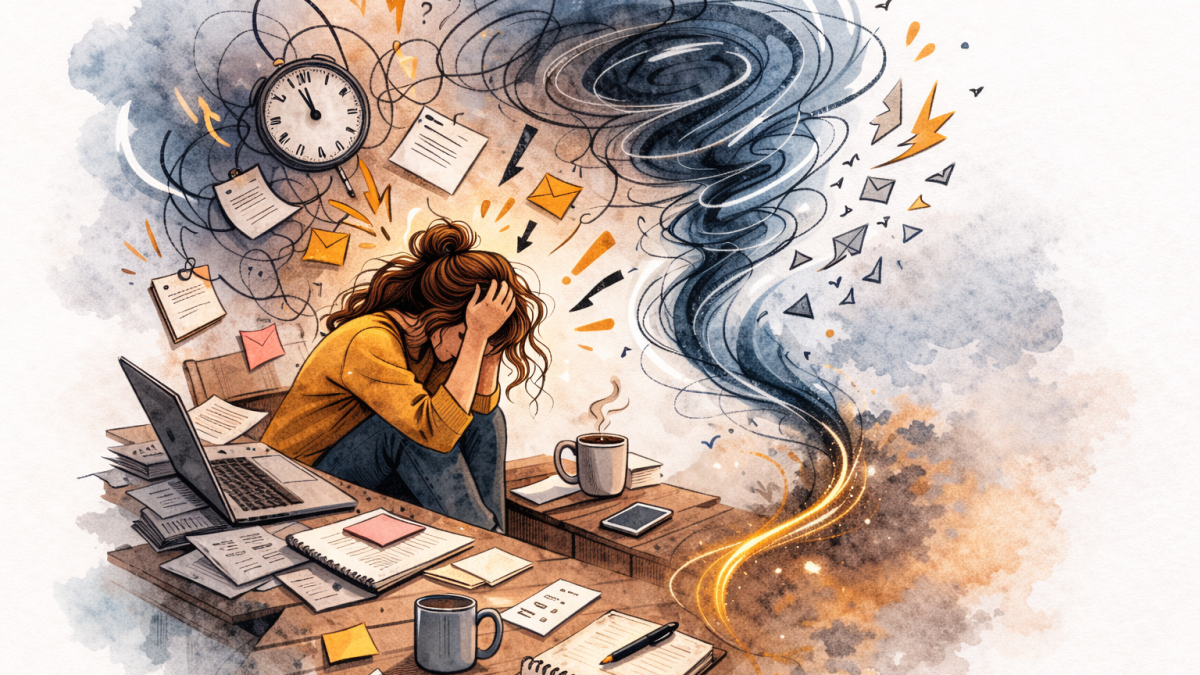
When projects feel like a test of your worth: ADHD, urgency, nervous systems, and how to interrupt the spiral with compassion.
Have you ever started working on something important — a project, an idea, even just a plan — and suddenly it feels massive?
Like, if you don’t get it exactly right, something terrible will happen. Like the success of the whole thing is riding on you, and if you mess up… you've failed. And maybe even you are the failure.
You’re not alone.
And if you have ADHD, this might sound painfully familiar.
The Spiral: Why It Feels So Big So Fast
You sit down to work — maybe even excited — and before you know it, you’re overwhelmed. You feel panicked. You’re fully in it.
It might sound like:
-
“This has to be amazing, or I’ve let everyone down.”
-
“If I don’t do this perfectly, I shouldn’t do it at all.”
-
“If I don’t have this figured out by now, something is wrong with me.”
These thoughts come fast. The urgency is loud. And the stakes feel impossibly high.
This isn’t just perfectionism. It’s not just stress.
It’s your nervous system and your ADHD brain colliding in a storm of urgency, intensity, and pressure.
And for many people, there’s another layer:
When you’ve built your life around being capable, being responsible, being the one who figures it out — anything important can start to feel like a referendum on who you are.
If it works, you’re enough.
If it fails, you’re exposed.
That’s a heavy place to create from.
What’s Actually Happening?
Here’s what might be going on underneath the spiral:
🔥 1. Emotional Intensity + Hyperfocus
ADHD brains often feel deeply. When you care about something — and many of us care a lot — your brain latches on with intensity. Hyperfocus kicks in, and suddenly this one thing becomes everything.
💥 2. Rejection Sensitivity
Many ADHDers experience Rejection Sensitive Dysphoria (RSD) — a fear of disappointing others or being judged. That makes any project or task feel like a test of your worth.
⚙️ 3. Perfectionism as a Coping Tool
If executive function has been hard (which is common with ADHD), perfectionism can become a way to feel safe — like, “If I do it perfectly, I won’t be criticized or misunderstood.” But it’s a heavy load to carry.
🧠 4. All-or-Nothing Thinking
ADHD often brings black-and-white thoughts. If it’s not perfect, it’s a failure. If I don’t know exactly how this ends, I can’t start. It’s exhausting and paralyzing.
Why Can’t I Catch It in the Moment?
This is the question I hear (and feel) often:
“Why can’t I just recognize what’s happening before I spiral?”
Here’s the honest answer:
When your brain perceives danger — emotional or otherwise — it goes into fight-or-flight mode. Logic shuts down. Your body’s job is now survival, not self-reflection.
So of course you can’t easily “think your way out” of the panic.
Your body and brain are trying to protect you.
So What Do I Do?
This is the part where you don’t need to fix everything.
Start with small interruptions to the spiral. Just enough space to breathe.
🛠 Try This:
1. Catch One Moment
Not the whole spiral — just one clue. A clenched jaw. A racing thought. A tight chest. Noticing that is progress.
2. Give It a Name
Call it “the tornado,” “panic mode,” or “the squeeze.” Naming it gives you distance: “Oh, this is my tornado. I know this.”
3. Create a Pause Tool
Write a sticky note, voice memo, or reminder that says:
“Pause. You’re safe. You can take a break. This project is not your worth.”
Put it where you'll see it often.
4. Recover with Kindness
Even if you don’t catch it in time — especially then — be gentle with yourself. You’re learning a new way to relate to your brain. That’s brave work.
Final Thought
If you’re deep in something that feels impossibly big, just know:
It makes sense that it feels that way.
And it doesn’t mean you’re broken. Or failing. Or too much.
You’re a person with a brain that processes urgency, emotion, and meaning differently — and once you learn to spot the spiral, you can start rewriting your response to it.
Not perfectly.
But slowly. Gently. Powerfully.
You’ve got this.
Curious about ADHD for yourself or a loved one?
If you’re curious about ADHD — or if you want something concrete to share with others — I’ve created a free ADHD Screening Toolkit. It includes two evidence-based screening tools that break ADHD down into symptoms and everyday struggles.
Many people who see these tools have that “oh wow, that’s actually ADHD” moment. It’s a simple way to paint a clearer picture of what ADHD really looks like.
👉 Access the FREE ADHD Screening Toolkit here!
Want More Support Like This?
If you found this helpful, I send out occasional emails with more posts like this, upcoming workshops, and new resources for ADHDers, self-healers, and helpers.
👉 Join the email list here to stay in the loop.