Why You Feel Irritable When Your Kids Interrupt You (It’s Not What You Think)
 Lindsey Peterson
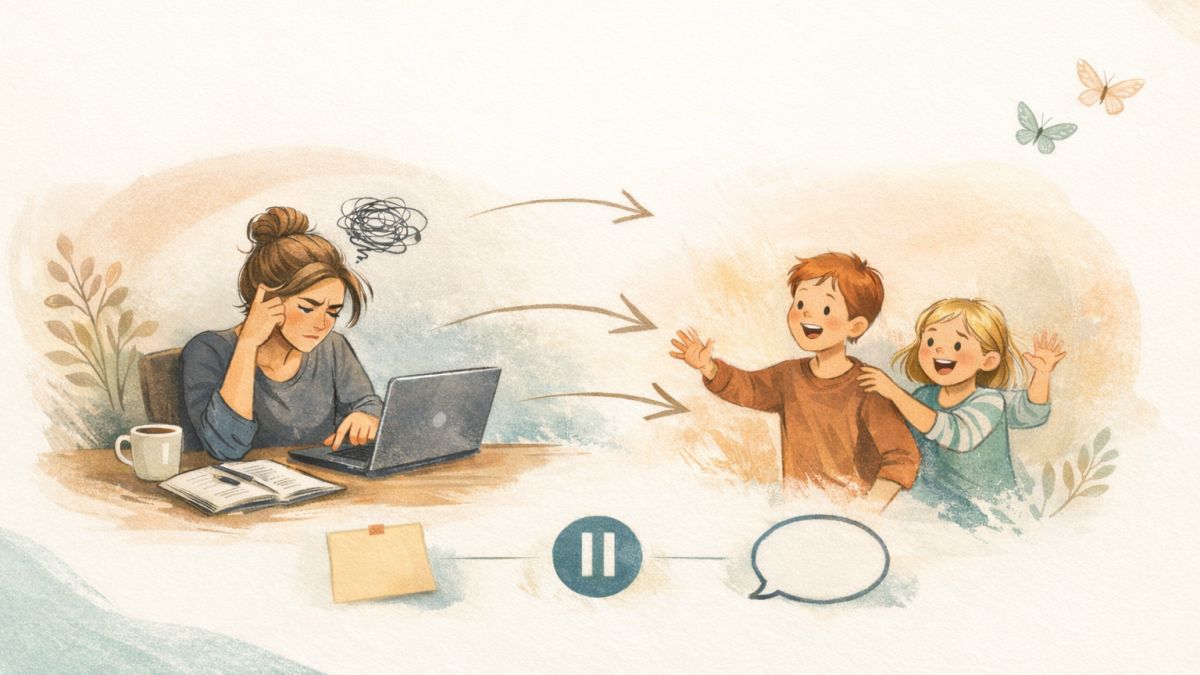
Why interruptions trigger irritability—task switching, brain overload, and simple ways to respond with more ease and connection.
You’re finally in it.
Focused. Clear. Maybe even enjoying what you’re doing for the first time all day.
And then—
“Mom!!”
Something in you snaps.
Not because you don’t love your kids. Not because you don’t want to be present.
But because something deeper just got disrupted.
Let’s talk about what’s actually happening—and how to handle it in real life.
The Truth About Task Switching
What looks like a simple interruption is actually a full cognitive shift.
When your child interrupts you, your brain has to:
- Stop what it’s doing
- Hold your place
- Shift attention
- Regulate your emotional response
- Engage in something completely different
All in seconds.
That’s called task switching—and it relies heavily on executive functioning.
Here’s the part most people miss:
It’s not just the switch that’s hard. It’s that you didn’t choose it.
That loss of choice creates tension in your nervous system. It can feel like being pulled out of something before you were ready.
Why It Feels So Much Worse in Certain Moments
Not all interruptions hit the same.
It’s especially hard when:
- You’ve been giving to others all day
- You finally have time to yourself
- You’re doing something you actually enjoy
- You just got into a flow state
In those moments, your brain isn’t just focused—it’s settled.
So when you’re interrupted, it can feel like:
“I just got here… and now I have to leave?”
That’s not just frustration. It’s a subtle sense of loss.
What This Looks Like on the Outside
Even if what’s happening internally is:
“I don’t have the capacity to switch this fast”
It often comes out as:
- Snapping
- A sharp tone
- Urgency or impatience
- “Just give me a second!”
And then… guilt.
What Actually Helps (In Real Life)
This isn’t about becoming endlessly patient.
It’s about creating micro-bridges between tasks so your brain can transition.
1. Name What’s Happening
Instead of judging your reaction, try labeling it:
“This is a forced task switch.”
This small shift:
- reduces self-criticism
- gives your brain context
- slows your reaction (even slightly)
2. Give Yourself a Pause Buffer
You don’t have to switch instantly.
Even 10–30 seconds helps.
Instead of reacting immediately:
“Hey, I hear you. Give me 20 seconds to pause this and I’ll come.”
You’re not ignoring your child—you’re allowing your brain to catch up.
3. Say the Transition Out Loud
Let your kids in on what’s happening:
“My brain is in the middle of something—I need a second to switch.”
This:
- models emotional awareness
- sets a boundary
- reduces internal pressure
4. Leave Yourself a Breadcrumb
Part of the resistance to switching is fear of losing your place.
Before you get up:
- jot a quick note
- say your next step out loud
- leave a visual cue
Example:
“Next: finish slide on emotional regulation.”
Now your brain can let go—because it knows where to return.
5. Don’t Force Instant Warmth
You don’t have to go from focused → fully present in one second.
Try a neutral entry point:
“Okay, I’m here. Show me.”
Let warmth build naturally instead of forcing it.
6. Repair When Needed
You will still have moments where irritation slips out.
That doesn’t undo anything.
What matters is repair:
“Hey, that tone was about me switching tasks—not about you. I’m here now.”
This teaches your kids something powerful:
emotions happen, and relationships can repair.
A Real-Life Moment (Walked Through)
You’re working on something meaningful. You’re in flow.
Your child calls out:
“Mom, I need help!”
Old Pattern:
“What?! I’m busy right now!”
(They feel dismissed. You feel guilty.)
New Pattern:
1. Internal awareness
“This is a forced switch.”
2. Verbal buffer
“Give me 30 seconds.”
3. Breadcrumb
(write down your next step)
4. Quick regulation
(one breath, release tension)
5. Transition
Walk over
6. Soft start
“Okay, what do you need?”
The Reframe You Might Need Most
Your irritation isn’t a character flaw.
It’s not a sign you’re doing this wrong.
It’s:
A capable brain being asked to switch too quickly, without choice.
One Small Shift That Changes Everything
Start saying this:
“Give me a second to switch my brain.”
It creates space—for you and for your kids.
And over time, it turns chaotic interruptions into more manageable transitions.
You don’t need to eliminate irritation.
You just need a bridge between where you were… and where you’re being asked to go.
And that’s something you can build, one moment at a time.
If You’re Thinking… Wait, Is This ADHD? 🧩
Maybe task switching is just one of those things you’ve always struggled with.
Maybe you’re also noticing the overwhelm. The forgetfulness. The procrastination. The emotional reactions. The feeling that your brain can handle a lot—until suddenly it absolutely cannot.
And now you’re wondering:
Could ADHD actually explain some of this?
That question is worth exploring.
Not because every struggle means ADHD. And not because you need to immediately pursue a diagnosis.
But because understanding why your brain works the way it does can change how you respond to it.
Wondering, “Do I Have ADHD?”
I created the Do I Have ADHD? workshop for adults who are in exactly that place—the “Okay... I’m starting to see myself in this. Now what?” stage.
We go beyond a quick symptom checklist and look at the bigger picture: what ADHD actually looks like in adulthood, masking, your history, how these patterns show up across your life, and what else could potentially explain what you’re experiencing.
You’ll also work through ADHD screening and reflection tools and learn how to actually make sense of what you find.
The goal isn’t to diagnose yourself.
It’s to help you make sense of your pattern, connect the pieces, and decide what comes next.
👉 [Explore the Do I Have ADHD? Workshop]
Want more practical ADHD education like this?
Join my email list for practical ADHD education, resources, new articles, workshops, and tools to help you better understand ADHD—and learn to work with your brain, not against it.
Whether you're wondering if you have ADHD, newly diagnosed, or have known for years—you’re welcome here.